If you’ve ever fired up a band saw for a quick cut, only to pull your workpiece off and find it leaning 10, 15, even 20 degrees off the line, you know how frustrating it can be—especially when you’re working with carbide band saw blades, which are supposed to deliver cleaner, straighter cuts than bi-metal alternatives. As a carbide band saw blade supplier who’s fielded dozens of calls from fabricators, woodworkers, and industrial maintenance teams asking this exact question, I can tell you crooked cutting isn’t just a “user error” myth. It’s almost always a mix of small, fixable issues with the blade, the machine, or how you’re setting up your material. Let’s break down the science behind why your blade’s cutting off-kilter, and what you can do to fix it. Carbide Band Saw Blade
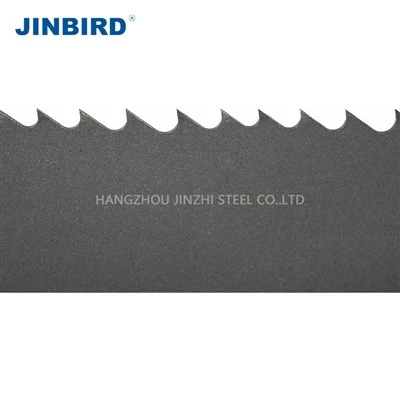
First, let’s start with the blade itself—and no, it’s not always a manufacturing defect. Carbide band saw blades are made with hard, tungsten-carbide teeth brazed to a flexible steel back, which makes them strong enough to cut hard materials like stainless steel, titanium, or dense hardwoods, but also sensitive to wear and misalignment. One of the most common culprits I see is a blade that’s not tensioned correctly. Tension is the force that holds the blade tight between the two band saw wheels, and it’s non-negotiable for straight cuts. If your tension is too low, the blade can flex or wander as it cuts, especially when working through thick material. For example, a 1-inch wide carbide blade meant for metal needs roughly 25,000 to 30,000 pounds of tension, but a lot of operators eyeball it instead of using a tension gauge—that’s a mistake. I’ve had a customer who was cutting 6-inch stainless steel billets blame a faulty blade, only to discover he’d set his tension to half the recommended level; cranking it up fixed the crooked cuts overnight. On the flip side, too much tension stretches the blade back, warping it so it won’t track straight on the wheels, leading to the same off-kilter result.
Worn or dull carbide teeth are another big one. Unlike bi-metal blades, which you can re-sharpen a few times before replacing, carbide teeth brazed to the blade’s back have a very specific cutting angle (usually 10 to 15 degrees for positive rake, depending on the material). When those teeth dull, they don’t just stop cutting cleanly—they catch or drag on the material, pulling the blade off its intended path. A dull tooth will push against the workpiece instead of slicing through it, creating sideways force that tugs the blade one way or the other. I had a woodworker last week complain his carbide blade was cutting crooked through oak planks, and when he pulled the blade off, we could see every other tooth was chipped and rounded from cutting pressure. Replacing that worn blade with a sharp one fixed his issue; he even said it cut 30% faster than before too. It’s important to note that carbide teeth wear evenly if the blade is run at the correct speed for the material—run a metal blade too fast for stainless steel, and the teeth will overheat, dull prematurely, and start pulling the blade sideways.
Next, blade tracking on the band saw wheels. The top and bottom wheels of your band saw keep the blade aligned as it moves, and if the blade isn’t tracking properly, it will drift off course. Tracking is adjusted using a wheel’s front-to-back tilt and a guide that sits just above the material cut line. A lot of operators skip checking tracking until the blade comes off the wheel, but even a slight misalignment can cause crooked cuts. For example, if the top wheel is tilted just 1 degree out of square with the bottom wheel, the blade will pull toward the side it’s tilted to as it moves. I once worked with a fabricator who had a custom band saw that his shop had relocated, and during the move, the wheels shifted slightly. His blade was cutting 2 inches off over a 10-foot cut; after resetting the wheel tracking to manufacturer specs, it was back to straight cuts. Also, blade guides—both the upper and lower ones that sit just above and below the cut area—need to be positioned correctly. If the guides are too far from the blade, the blade can flex from the cut pressure; too close, and it wears the back of the blade unevenly. We recommend setting guides so there’s no more than 1/8 inch of space between the guide and the blade’s back for thin blades, and 1/4 inch for thicker, heavy-duty blades.
Then there’s the workpiece itself. A lot of people assume the blade is the problem, but if your material is warped, twisted, or not clamped straight to the saw table, it will pull the blade off course as it cuts. For example, a steel plate that’s been sitting in your shop for months and has developed a slight bow will sit unevenly on the table; when the blade cuts, it will follow the bow instead of a straight line. The same goes for wood that has cupped or twisted grain—carbide blades can cut through it, but if the material isn’t held tight and flat, the grain will pull the blade to one side. Another common issue: not supporting long workpieces. If you’re cutting a 12-foot steel beam on a band saw without a roller stand or support at the far end, the beam will sag, creating an uneven cut surface that tugs the blade sideways. We always advise customers to use a material support equal to at least half the length of the workpiece to keep it flat and steady during cuts.
Let’s also talk about kerf and blade width. The kerf is the narrow slot the blade cuts, and a wider blade (3/4 inch or more) has less tendency to wander than a narrow blade (1/4 inch or less) because it has more surface area to stay aligned. If you’re using a 1/4-inch wide carbide blade for a 6-inch thick steel cut, it’s going to be more prone to crookedness than a 1-inch wide blade designed for that thickness. It’s not a rule, but choosing a blade width that matches your material thickness—1/2 inch width for up to 4 inches thick, 3/4 inch for 4 to 8 inches, etc.—reduces side flex and keeps the cut straight. We have a guide on our website that matches blade width to material type and thickness, and a lot of customers tell me switching to the right width made a bigger difference than anything else when they were dealing with crooked cuts.
Wait, there’s one more less obvious issue: residue buildup on the blade. Carbide blades run hotter than bi-metal blades during cuts, especially when cutting metal, and that heat can cause metal chips, oil, and coolant to bake onto the blade’s teeth and back. This buildup creates uneven weight on the blade, pulling it off course as it moves. I had a machinist who was cutting aluminum parts tell me his blade was cutting crooked, and when we pulled it off, we saw thick, caked aluminum buildup on one side of the teeth and back. Cleaning the blade with a wire brush and a degreaser fixed the issue temporarily, but he started using a coolant mist that reduced heat buildup and prevented that caking—his cuts were straight after that. That’s a small fix, but it’s easy to overlook when you’re focused on tension or sharpening.
Now, let’s separate the blade-related issues from the machine-related ones, because that’s where a lot of confusion happens. A lot of carbide band saw blade suppliers will tell you a blade is defective when it’s actually a machine problem, and vice versa. For example, if your band saw’s table is not square to the blade, every cut you make will be crooked, no matter how sharp your blade is. A simple way to check this is to make a test cut on a scrap piece of wood, then measure the angle between the cut edge and the table. If it’s off, you’ll need to adjust the table alignment, not the blade. Another machine issue: worn drive wheels or a loose motor belt. A loose belt can cause the blade to speed up or slow down unevenly, leading to inconsistent tooth cuts and crookedness.
So, what’s the step-by-step fix if your carbide band saw blade is cutting crooked? First, start with the basics: check your tension with a gauge, set it to the manufacturer’s recommendation (usually 15,000 psi for light cuts, 30,000 psi for heavy metal cuts). Next, check your tracking: adjust the wheel tilt so the blade runs evenly, no more than 1/16 inch of space between the blade edge and the wheel’s guide. Then, inspect your teeth: if they’re dull, chipped, or worn, replace the blade—don’t try to keep running it, because it will only get worse. Check your guides: make sure they’re positioned 1/8 to 1/4 inch from the blade, depending on width. Then, set up your workpiece: clamp it straight to the table, use supports for long or heavy materials, and make sure the material is flat and free of warps. Finally, clean the blade to remove any buildup that might be causing uneven weight.
At the end of the day, crooked cuts with carbide band saw blades are almost never a one-size-fits-all problem. It could be tension, tracking, wear, setup, or the machine itself. As a supplier, I’ve seen every scenario: from a customer who kept replacing blades thinking they were bad, when the real issue was his band saw table was 2 degrees out of square, to a woodworker who was using a 1/4-inch blade for 8-inch thick oak planks. The good news is, most of these issues are easy to fix once you identify the root cause.

If you’ve tried these steps and your blade is still cutting crooked, it might be time to talk through your setup with someone who works with carbide blades every day. We’re here to help—whether you’re troubleshooting a persistent issue, choosing the right blade for your material, or just looking for advice on maintenance that will keep your cuts straight. Don’t hesitate to reach out to discuss your specific needs, and we’ll point you in the right direction to get your band saw cutting true again.
Tooth Hardend for Wood Cutting References:
- Machinery’s Handbook, 31st Edition: Band Saw Blade Tension and Alignment Guidelines. Industrial Press, 2020.
- Carbide Band Saw Blade Technology: Wear Patterns and Cutting Path Stability. Journal of Manufacturing Processes, Vol. 45, 2021.
- Band Saw Machine Setup and Maintenance Manual. American Saw and Blade Association, 2019.
- Woodworking and Metalworking Band Saw Best Practices. Fine Woodworking Magazine, Vol. 35, No. 2, 2022.
Hangzhou Jinzhi Steel Co., Ltd.
Hangzhou Jinzhi Steel Co., Ltd. is one of the most experienced carbide band saw blade manufacturers and suppliers in China, also supports customized service. Please feel free to buy discount carbide band saw blade in stock here from our factory. Contact us for pricelist.
Address: No. 1, 118 Donggang Road, Xingqiao, Linping, Hangzhou, Zhejiang, China
E-mail: sales@jinzhi-steel.com
WebSite: https://www.jinzhi-steel.com/
